A coach once gave me this question that has plagued me ever since: If you had 10 years, how would you want — really, truly — to live? Who would you be with? What would you be doing?
Back in my early twenties, I hated this question. I encountered a similar version it in scholarship interviews and job applications (“What do you want to do in ten years?” How the heck am I supposed to know the future, let alone what I want to do in it?)
What I didn’t appreciate then is this: if you don’t know, then finding out has to be the answer.
“What is it that you want to do with this one wild, precious life?” as the poet Mary Oliver wrote.
(Why ten years, and not one or five?
I find the time frame long enough to build something real and short enough that you can feel the edges.
Ask it seriously and it clears away a lot of noise.)
Now in my 30s, I know a little bit better.
But lately, when I ask this question again, I notice something unsettling: ten years feels generous. Maybe too generous.
The time now feels a lot more urgent, and as my teacher Bayo Akomolafe once said “The time is urgent; let us slow down.”
Let us slow down to experience what’s truly precious.
A revised 2x2 that makes more sense.
You probably know the Eisenhower matrix. Important vs. Urgent. It’s useful — it at least tells you how to prioritize your inbox.
But “important” is a judgment call. It’s cognitive & detached. You can know something is important and still scroll past it. “Important” doesn’t make you book the flight.
What I’ve been reaching for is a different word: precious.
Precious isn’t a strategic assessment. It’s felt in the body.
It is the thing you’d protect first in a fire.
It is the thing that feels like on fire when you cannot protect.
You can’t think your way into precious — and you can’t unknow it once you feel it.
So here you go my revised Eisenhower matrix, updated for this wild, precious time.
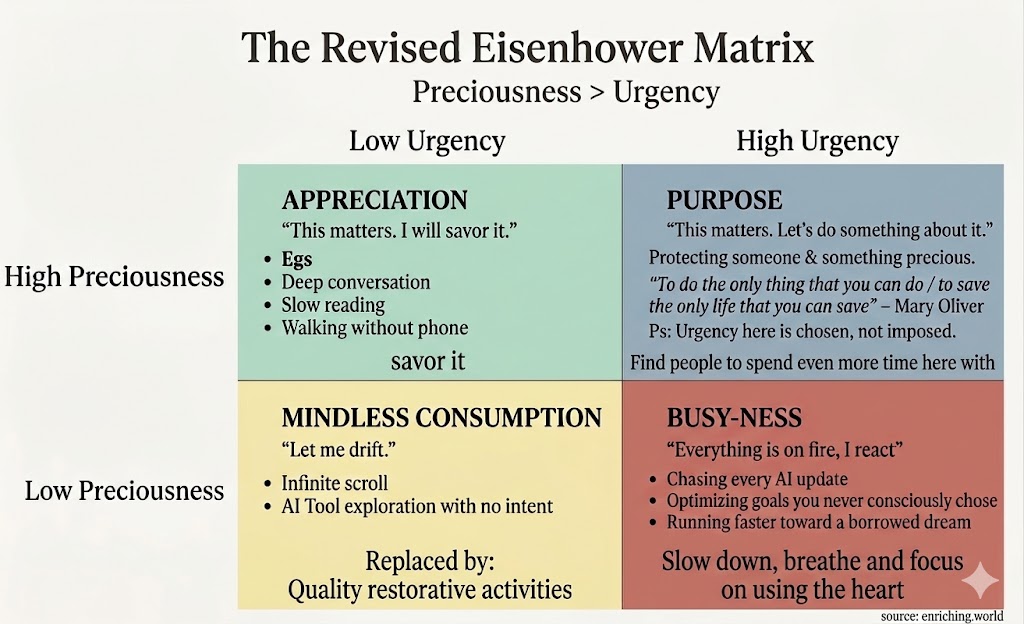
I. Preciousness
A close friend recently had his first child. For the month before the birth, he described feeling effectively dead — confined indoors, major routines suspended (no chill coffee in the morning). He was entirely there for his wife, both of them waiting.
Then his daughter arrived.
He told us: “The moment my daughter came out, I felt like a rebirth. For me.”
A new life brings new life, literally.
He’s a hyper-independent German — not someone we’d expected to say this. But during a week-long work trip, he told us he regretted not booking the flight home on the weekend just to see her. She’s changing every week, and he doesn’t want to miss it.
That is preciousness when it is visceral: a man in a hotel room, wanting nothing except to be somewhere specific, with someone specific, for reasons that require no justification at all.
What struck me is that his preciousness didn’t make him passive at all. It made him sharper. He runs his own business precisely because it gives him the flexibility to be there for his daughter in a way a conventional job wouldn’t allow. His preciousness and his urgency point the same direction.
Deep down, I long for that kind of preciousness. I hope I don’t need a daughter for it. But I understand it now in a way I didn’t before.
Without preciousness, life is competent but hollow. You can optimize, accumulate, and chase status game — and still feel that something essential is missing.
Because it is.
II. Urgency
Preciousness alone can become its own trap.
You can love deeply, feel grateful every morning, and still never do the thing the world is asking of you. Preciousness without urgency is beautiful. It’s also passive.
Which is fine for many, but not for me, and I believe for people like us.
So there has to be an element of urgency ( and definitely NOT the manufactured urgency aka countdown Black Friday sales).
Here’s a question for you: Can you believe it’s been five years since COVID?
I know right. Where the fuck did time go?
(ps: Vietnam just built this COVID memorial, and it’s beautiful)
The world right now is providing a similar urgency whether we want it or not.
Different events, same feeling.
AI isn’t coming — it’s here, reshaping entire industries and people’s working identities while most people are still deciding how seriously to take it.
The global order is under pressure in ways that have no clear precedent. (Many people messaged me recently, relieved I was no longer in Dubai given the instability in the region. Thank you for your care.)
What I realized after coming up with this framing is this: Lots of AI conversations sits squarely in the bottom-right quadrant. High urgency, low preciousness.
Nobody is flying home to see their AI agent (well, maybe some.. but c’mon bros - you guys better work on your preciousness).
AND AI conversations generate enormous pressure to act — adapt, upskill, reinvent — but it carries no inherent meaning.
Left unchecked, AI doesn’t move you toward purpose. It moves you toward busy-ness. More tools, more noise, more reactive motion in directions you never consciously chose.
The discomfort you feel about all of this is normal. The urgency is real.
But urgency without preciousness is just the bottom row of the matrix. Or as a good friend of mine said, “busy being busy.”
III. Purpose: when both axes are live
What I am now understanding: purpose is not a destination you find. It’s what happens when preciousness and urgency point in the same direction, at the same time.
The author Jonathan Goodman has two questions he uses to test whether any work is worth doing:
Does doing it make you a better person for having done it?
Does it bring you closer to the people you love?
These are simple in the way that only the right questions are simple. The first asks whether the effort has real integrity — whether the challenge shapes you, not just your output. The second is the filter most people forget to apply until it’s too late.
A lot of ambitious work fails the second test. It consumes the life it was supposed to fund. It pulls you away from the people you’re doing it for and returns you too depleted to be present when you do show up.
(Think about the cliche hard-working parent who is always at work and not present for the child. I grew up like that with my single working mom, and it has a major impact on me later on to heal from. The old adage about how to be with children, “half the money, twice the time” makes lots of sense here).
My friend’s work passes both tests. Running his own business is genuinely hard — and it’s making him sharper, more capable, more alive to what matters - i.e his family.
His preciousness and his urgency reinforce each other.
So what?
That alignment is not automatic. It has to be consciously chosen.
The irreducible human thing — the thing AI cannot replicate — is exactly this: the knowing in your bones what is truly precious and urgent, and brings that knowing into your work, relationships and leadership.
Not your strategic self. Not your optimized self. Your self that is fully present in a moment that won’t come back, whether in observing appreciation or passionate action.
These things are yours. Don’t outsource the awareness of them in this age of AI.
—